Sunday, November 7, 2021

 Paper Mache Volcano

To create the volcano, you will need:
1 cup
1 piece of cardboard that fits in the bottom of your _____ (mess makers) bin.
Flour
Water
Mixing bowl
Newspapers
 Optional Items:
Masking Tape
White School glue
Begin by centering the cup on the cardboard piece.  


Take a few pages of newspaper and twist them into donuts.  Form them around the bottom half of the cup to begin shaping the volcano.  If you need to, you can use masking tape to help hold it together.


Next, whisk about 4 oz. of flour with about 4 to 8 oz. of water.  The mixture should have a consistency that is just a little bit thinner than paint.  If you want to, you can add a little bit of school glue to the mixture, but it isn't necessary.  Just make sure you get out all the lumps.


Tear newspaper into strips, 1 to 2 inches wide.  Add only a few strips of newspaper into the flour and water mixture at a time.  Wipe off excess and begin wrapping around the volcano.


Do not be in a hurry.  This process may take a few days to complete.  Wrap a few layers and then allow it to dry overnight.  Then, add another few layers and allow it to dry.  


Once your volcano is complete, allow it to completely dry before you paint it and especially before you conduct your experiments!


For the Volcano Eruption Experiments:
First some volcano facts:
The Alaska Volcano Observatory tells us that there are 130 volcanoes in Alaska.  

Since the 1700s, some 50 volcanoes have erupted and are called active. Most active volcanoes in Alaska are found along Cook Inlet and down through the Aleutian Islands. Inactive volcanoes, those that haven't erupted for several hundred years, can be found in every region of the state.

Alaska has 80 percent of all the active volcanoes in the United States and 10 percent of those found in the world.
Fourpeaked Volcano erupted in September 2006 for the first time in 10,000 years, proving that long sleeping volcanoes can wake.

Sources:

http://www.avo.alaska.edu/ Alaska Almanac. Alaska Northwest Books, 2008Alaska's Volcanoes, Alaska Geographic, Volume 18, Number 2Alaska's Natural Wonders, Bob Armstrong and Marge Hermans, Alaska Northwest Books, 2000

Baking soda Chemical reaction:
When the chemicals are added together, it produces foaming bubbles.  What causes the bubbles?  
Baking soda has another name, it's chemical name, sodium bicarbonate.  
Vinegar is a diluted acid.

The solid baking soda was placed in liquid vinegar producing carbon dioxide gas, which is evident because of the formation of bubbles in the foaming mixture. Eventually all of the solid dissolved and reacted producing a new liquid solution.

During the reaction, a solid and liquid have been chemically reacted to form a gas and a liquid. This experiment can also be used to explain foams, as liquids or solids containing gas bubbles.

Source
there is a chemical reaction when the baking soda and vinegar are mixed.  
Elephant toothpaste reaction:

The yeast contains an enzyme called Catalase that breaks down hydrogen peroxide (H2O2) into oxygen gas and water. The oxygen gas gets trapped by the soap, and you get a large foamy solution that squirts out of the top of the bottle!

The cool thing about this activity is that the enzyme Catalase can also be found in potatoes, dogs and even us! We have the same enzyme in our bodies. That is why you see the 3% hydrogen peroxide bubble when you put it on a cut or scrape. The oxygen released is what kills the germs in the cut. We have this enzyme because we naturally produce low amounts hydrogen peroxide as a byproduct of oxidative metabolism (the way that a cell gains useful energy). Our cells need energy, but low amounts of hydrogen peroxide are produced and need to be neutralized through enzymes like Catalase.

https://www.imaginationstationtoledo.org/education-resources/diy-activities/elephant-s-toothpaste/
  1. A chemical reaction is a process in which substances undergo a chemical change to form a different substance. In this reaction, the hydrogen peroxide is catalyzed by the yeast to release the oxygen molecules. The foam is oxygen-filled bubbles that result from the hydrogen peroxide being broken down into water (H2O) and oxygen (O2).

    This reaction uses yeast as a catalyst. A catalyst is a substance that increases the rate of a chemical reaction. In this case, the yeast helps to separate the oxygen from the hydrogen peroxide.

    In this reaction, the bottle will feel warm to the touch because it is an exothermic reaction. This means that the chemical reaction releases heat as it occurs. The opposite also demonstrates a chemical reaction. An endothermic reaction would feel cool to the touch.

https://orise.orau.gov/resources/k12/documents/lesson-plans/elephant-toothpaste.pdf

Baking soda reaction:
1 tsp of Baking soda (in a 2 oz cup)
1/2 tsp of dish soap (*in a 2 oz cup)
2 tsp of water
2 oz vinegar (in a 4 oz cup)
mix baking soda, water and dish soap together in cup.
add vinegar.
materials:
spoon
10 oz drink cup
Elephant toothpaste reaction:
1 Tablespoon dish soap (*2 oz cup)
4 oz peroxide (4 oz cup)
1 T dry yeast (2 oz cup)
3 T water.
mix water and yeast together and set aside.
mix peroxide, dish soap and water in cup
after yeast mixture has sat for at least 30 seconds, add yeast to peroxide


Baking soda reaction:


Elephant Toothpaste Reaction:


Friday, April 12, 2019

Homemade Cream of Mushroom Soup

  • 1/2 to 1 lb fresh mushroom 
  • 1 onion
  • 2 cloves fresh garlic
  • 1/4cup butter 
  • 1 tsp salt
  • 1/2 tsp pepper
  • 2 TBSP arrowroot powder
  • 1 quart stock - preferably homemade beef, chicken or vegetable
  • 1/2 cup heavy cream 
  • 1/2 cup sour cream 
  • 1/2 brick cream cheese

Instructions

  1. Chop mushrooms and onion and mince garlic.
  2. Melt butter in a large pan and add chopped mushrooms and onion.
  3. Saute until translucent and cooked.
  4. Add garlic and saute an additional 2 minutes.
  5. Sprinkle with salt, pepper, and arrowroot and stir.
  6. Add broth and simmer about 10 minutes until it starts to thicken.
  7. Add cream and sour cream and stir in until smooth.
  8. Serve as a soup or use as cream of mushroom soup in recipes.

Birch Syrup Frosting

I only bake maybe once a year, on my wife's birthday, when I make her a birthday cake.  This year I made cup cakes.  I am also in the process of processing Birch water (sap) that we have collected from Birch trees on our property and cooking it down into Birch Syrup.  So I thought to myself and said, "Self, why not make Birch Syrup Frosting for the cupcakes!".  Well, not knowing much about baking and making frosting, I took to the interweb and couldn't find any Birch Syrup Frosting recipes.  They were all Maple Syrup recipes.  So, here is my Birch Syrup Frosting Recipe that I concocted with the help of a 1976 Better Homes and Gardens New Cook Book Recipe.  Yes, they get the credit for this, I just simply adapted their recipe.

3 ounces of cream cheese, softened
1 Tablespoon unsalted butter, softened
3 Tablespoons Birch Syrup
1 1/2 Cups sifted confectioners sugar


Mix together the cream cheese and butter, beat on low until creamy.
Add Birch Syrup.
Gradually add sugar.
If it becomes too thick, add just a little bit of milk.  For this batch, I added 1 T milk.

This frosted 12 cupcakes.

Thursday, August 2, 2018

Dragonfly Dad


A dragonfly to inspire you … and carry your stuff.


This dragonfly symbolizes the resiliency of life in Alaska, plus it’s just plain fun! 

If you tug on its wings a little, it might wiggle and adjust--but it will still go back to its original shape.


I’m a stay at home dad and love to teach my children about life; in turn they teach me what life is all about.  They love dragonflies and help me make these keychains -- a learning process for both of us.
         

Here’s hoping this dragonfly inspires 
        you to be flexible and adaptable no matter what the situation!
                                                          
by Dragonfly Dad                                                         
          resiliency educator not an art teacher

All of my supplies are "Made in the USA".  Paracord, split ring key rings, and beads are all "Made in the USA".  


To follow our learning journey, or purchase a Dragonfly, check out: 
   
         Dragonfly Dad on Facebook or check out our Etsy shop at:  https://www.etsy.com/shop/AKDragonflyDad

Veteran owned.  Handcrafted in Alaska.


Sunday, April 29, 2018

Camping off the Hurricane Turn Flagstop Train

Our first trip on the Hurricane Turn Flagstop Train out of Talkeetna, AK was a sightseeing trip to Hurricane Gulch.  As amazing as the sights were, it turned out to be an educational trip for another trip a year later.  You see, the Hurricane Turn Train is one of the last Flag Stop trains left in America.  You can jump on or off the train at any time along the route.  You just flag it down when you need to get picked up.
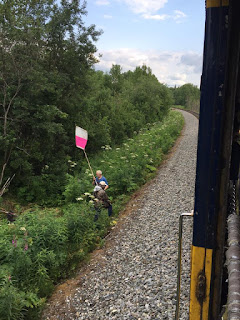
Homesteaders flagging down the train.
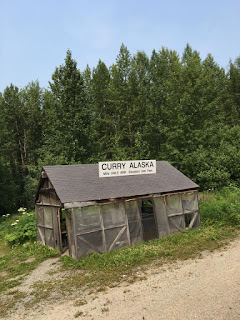
The train runs 5 days a week and departs out of Talkeetna station.  It goes to Hurricane Gluch, then goes back the other direction to Talkeetna.  Along the way it passes through Chase, Curry, Sherman, Gold Creek, Twin Bridges, and Chulitna.  There are many homesteaders out in these parts and this train is how they get back and forth into town when they need to. There is a TV series on Destination America called Railroad Alaska.  Some of these homesteaders are featured on this show and we have met a few of them.  The show can also be found on Amazon Video.   There are also several rafting companies that use this train to get to the locations they take their customers to put in.
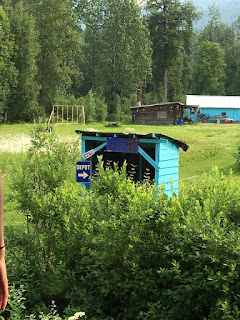
Sherman, Alaska

Curry, Alaska.


Here is a link for more information about the the Hurricane Turn Flagstop Train.
Alaska Railroad Hurricane Turn Flagstop Train

During our first Hurricane Gulch trip, along the way we noticed a few places where people where camping and fishing.  As remote as the area was, we really liked the idea of camping away from, well, everything.  So we began planning our 2017 summer camping trip.  We would pack all our stuff, throw it on the train, then jump off somewhere along the route near a river or stream so we could fish.  But we could not find any information about camping along the train route.  We had several maps, called Alaska State Parks, and even called the rangers at Denali National Park, but there was no information to be found.

So, we went ahead with our plans anyway and hoped for the best.  We were sure everything would work out.  We decided we would only camp 1 night.  Since the train drops us off and would not be back for another 24 hours to get us and since we had a 2 year old toddler with us, we thought one night would be enough to "test the waters".

We were ready for almost anything.  Besides typical camping gear like tent and sleeping bags, our packing list included:
44 Mag. handgun
12 gauge shotgun with slugs
2 cans of bear spray
Battery operated bear fence
2 Bear vaults = containers used to hold food so bears cannot get into them.
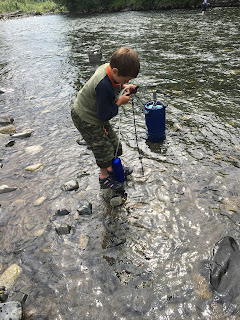
Water filter
Jet boil and fuel cans
Fishing gear
All of our food was either PB sandwiches or food that you just add boiling water to like oatmeal or dehydrated meals - like Mountain House backpacking meals only we made up our own.
We had a  Personal Locator Beacon (PLB) and we also rented a Satellite Phone.  Again, the train doesn't come back for 24 hours and we wanted to be prepared.

After we got onto the train, stowed our gear and got settled for the ride, we began talking with the conductor, Warren.  Of course he wanted to know where we were headed and when we didn't know specifically where to tell him to stop the train, we had to get it figured out.  Well, after just a few minutes of describing what we saw from the previous year, he knew exactly where we wanted to go.  And, as it turned out, there was a another group of 5 couples headed to the same spot.  After further conversation with this group, it turns out they were the same group we saw the previous year at one of the spots.
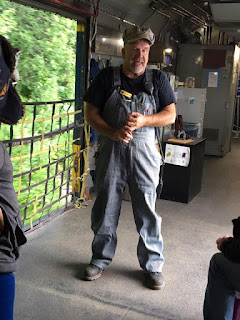
Conductor Warren = he is the BEST!  And great with the kids!

The train stoped at the area we wanted to camp at along the stream.  We all started unloading gear.  Everyone, even those not getting off, helped pitch in.  One last look in the baggage car, all our gear was out, then the train pulled away.  Now we had to set up camp.  We schlepped gear to the spots big enough for tents.  The larger group was very courteous.  They had 2 kegs of beer they went directly into the stream.  They assured us they wouldn't get rowdy and if they did, to just say something.  They offered to share their beer, too.  This group, by the way, was staying for nearly a week!  Maybe some day we will be able to do that, but not this trip.
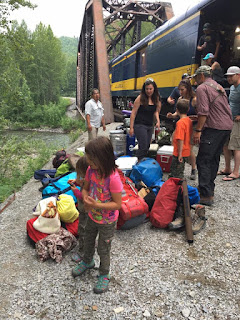
We all unload our gear.  Everyone pitches in to help.

Filtering Water for our dinner.
We set up camp, ate some snacks, fished, and built a campfire.   The next morning we had breakfast, fished, took a short hike and packed up camp.  Once the train went past, the train made a quick stop before continuing on to Hurricane Gluch.  2 other campers were getting off.  We checked with Warren the Conductor about an estimated time they would be back to get us.  The train pulled away and we went back to fishing.  When it was getting close to the time we expected the train to return, we carried our gear to the side of the train tracks and waited for it to return.
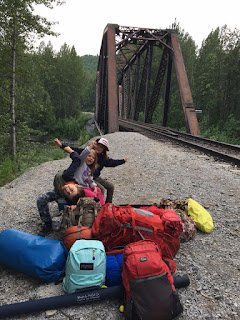
Waiting for the train to pick us up.
You see, there is no real definite schedule for this train.  It may be held up by a moose or bear along the tracks or by one of the several Denali sightseeing trains, which have priority.  So the Hurricane train would need to come to a siding and wait for the other train to pass.
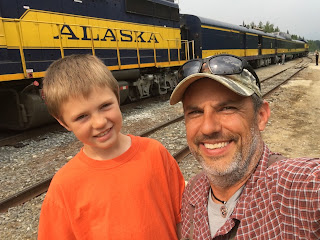
At a siding, waiting for a Denali sightseeing train to pass.

Eventually, the train arrived, we loaded our gear and headed back to Talkeetna.  We did not encounter any bears, although they are in the area.  The larger group that camped with us was amazing and even though we ended up having people near us, it was a bit of a reassurance having some other people around for our first time out there.

There are several spots you can camp along this route.  We suggest you take the train once as a sightseeing trip and find the location that best suits you.  Be sure to get place names or railroad mile posts RRMP numbers of where you would want to stop.  Also remember the train only runs 5 days a week, so plan your trip accordingly. 
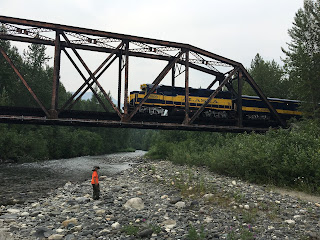
Hurricane Turn train headed back to Talkeetna, leaving us to camp and fish!


Here fishy, fishy, fishy....


Saturday, April 7, 2018

Paracord Dragonfly Keychains

More color options coming. 
Available for ordering.

Survival Grenade

My son wanted to make a paracord tank for his best friend and fellow Cub Scout who was leaving.  I had no idea how to make a paracord tank, so we found a picture of a paracord grenade.  Specifically a survival paracord grenade. 

We found an emergency blanket, small pocket knife, a magnesium/ferro rod fire starter and scraper, and an emergency whistle.
We packaged those items up into a small pouch then began weaving the paraord around it.
We used the scraper from the magnesium/ferro rod fire starter as the "spoon" for the grenade.